
Story by Glyn Mon Hughes
It was George Bernard Shaw who allegedly said, in 1942, that England and the United States were ‘two countries separated by the same language’.
The truth is that nobody is entirely certain where he said it, when he said it, or whether he actually said it at all. The quotation is often misquoted – or, perhaps, varied would be a kinder expression – and people attribute the saying to Oscar Wilde or to Sir Winston Churchill, amongst many others.
In many ways, that lack of agreement epitomises language differences and difficulties the world over and it is nothing new.
As far back as the 1920s, Rotarians in Britain and France planned to begin working together for ‘Peace and Understanding’.
But, before doing anything to promote to peace and understanding, the first hurdle on their path to peace was to come to an agreement as to which language they would use for future communication. That, as people even today might predict, proved to be hugely difficult.
In true Rotary style, however, whenever there is a problem someone will soon be along with a solution. That’s when several Rotarians came together to form Rotaria Amikaro De Esperanto – RADE - or the Esperanto Fellowship of Rotarians. Their aim was simple: to promote the use of Esperanto among Rotarians from a range of different linguistic backgrounds.
The foundation of the Esperanto Fellowship took place in 1928 and it still continues today. Indeed, it is the oldest of all the Rotary Fellowships.
In 1928, Rotary was still a relatively new organisation. It was two years away from its quarter century anniversary but it was acutely aware that it was expanding rapidly away from its beginnings in the USA.
But one of the downsides to this expansion was that a truly international movement would soon stumble upon a linguistic problem, namely that as the organisation expanded internationally it would need to operate in several different languages. The thinking, at the time, was that there would be a need for an auxiliary second language – whatever that might be.
Indeed, some Rotary clubs believed, as a practical aspect of service under the Sixth Object of Rotary, that agitating for the teaching of a common language in all schools would create a generation of adults with a common language. Clearly, that has not happened in the way that, perhaps, those early Rotarians envisaged.
Today, the United Nations uses six official languages: Arabic, Chinese, English, French, Russian and Spanish.
Ethnologue is a Dallas-based international organisation which researches almost 7,200 known living languages around the world. “The languages we use are part of what makes us what we are; they give us community and meaning,” they say.
Their research shows that, by the early 2020s, English is by far the most widely spoken language on the planet, with 1.5 billion speakers: 400 million native speakers and 1.1 billion people who have learnt the language.
Compare that with the second most widely spoken language – Mandarin Chinese – whose 1.2 billion speakers are largely concentrated in China.
The problem, too, is that the top 20 most spoken languages all have vastly different vocabularies and grammatical constructions. Compare Turkish with Bengali, for instance, or Hindi with Russian, Spanish with Vietnamese. These languages are also, largely, confined to specific geographical areas and lack the global range and appeal of English.
This problem was evidently becoming something of a stumbling block in the late 19th century.
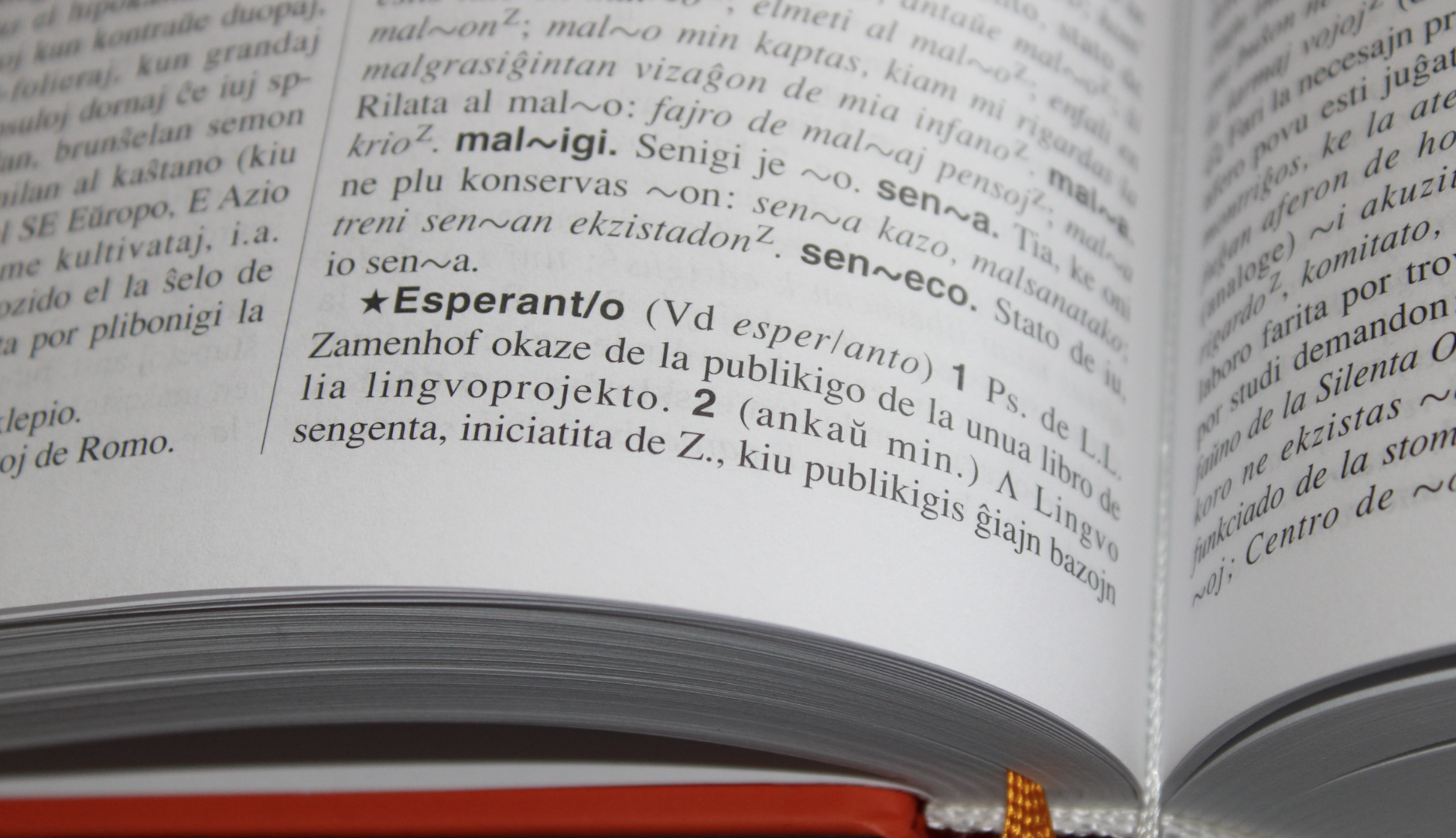
Solving this problem was key to Ludwik L. Zamenhof, a Polish linguist and ophthalmologist who created Esperanto in 1887.
Zamenhof set out to establish this artificial language as an international language or medium of communication, based on roots from the chief European languages, but with the advantage of grammatical regularity, ease of pronunciation and freedom from nationalistic concerns.
Going on a century and a half after Esperanto was given to the world, it is now the most widely spoken constructed auxiliary language on the planet.
Rotarians have taken up the challenge of communicating on a global basis and the long history of RADE has seen the fellowship promoting the benefits of a common language for Rotarians worldwide. It also provides information to its global membership through its
newsletter.
Rotarians who speak Esperanto are concentrated not only in the UK but also in Andorra, Belgium, France, USA, Germany, Russia, Poland and Spain. There are also large concentrations of speakers in Italy and Brazil as well as Australia, China and Japan.
The trailblazing Esperanto Fellowship has proved that there is a lasting desire for people to communicate easily one with another, for not only did they enhance contact between nations, but they also spawned an incredible array of other Rotary fellowships.
As they might say: Rotary kaj Paco tra la Tutmonda - kaj longe daŭru ĝi.
That is: Rotary and Peace the World Over – and Long May it Last.
To find out more about the Rotary Esperanto Fellowship visit: http://rade.fontoj.net/
Published in Rotary Magazine September 2025